


While performance measurement has always been a major concern for marketers, the discipline is now more critical and more complex than ever. With the end of third-party cookies, the fragmentation of channels (Connected TV, TikTok, Retail Media, Influencer marketing) and growing pressure on budgets, measuring the real effectiveness of media investments has become a genuine balancing act for marketing departments. The historical solution to these measurement challenges? Marketing Mix Modeling, or MMM.
Marketing Mix Modeling (MMM) seeks to measure the causal impact of marketing spend (media, sponsorship, pricing, promotions) on a specific performance KPI (sales, revenue, customer acquisition). Historically, MMM has relied on econometric methods designed to determine the exact impact of a change in media budget on a core business metric. It provides a rigorous answer to a question that is crucial for any CFO or CMO: "If I cut or reduce a given marketing lever, what is the exact impact on my sales?"
Yet while a large majority of major advertisers now use Marketing Mix Modeling (MMM) to steer their investments, only a minority say they are truly satisfied with traditional solutions. Indeed, traditional approaches run into major roadblocks:
At the same time, on the methodological front, the market is undergoing a transformation, gradually moving away from frequentist approaches2 focused solely on explaining the past in favor of Bayesian models.
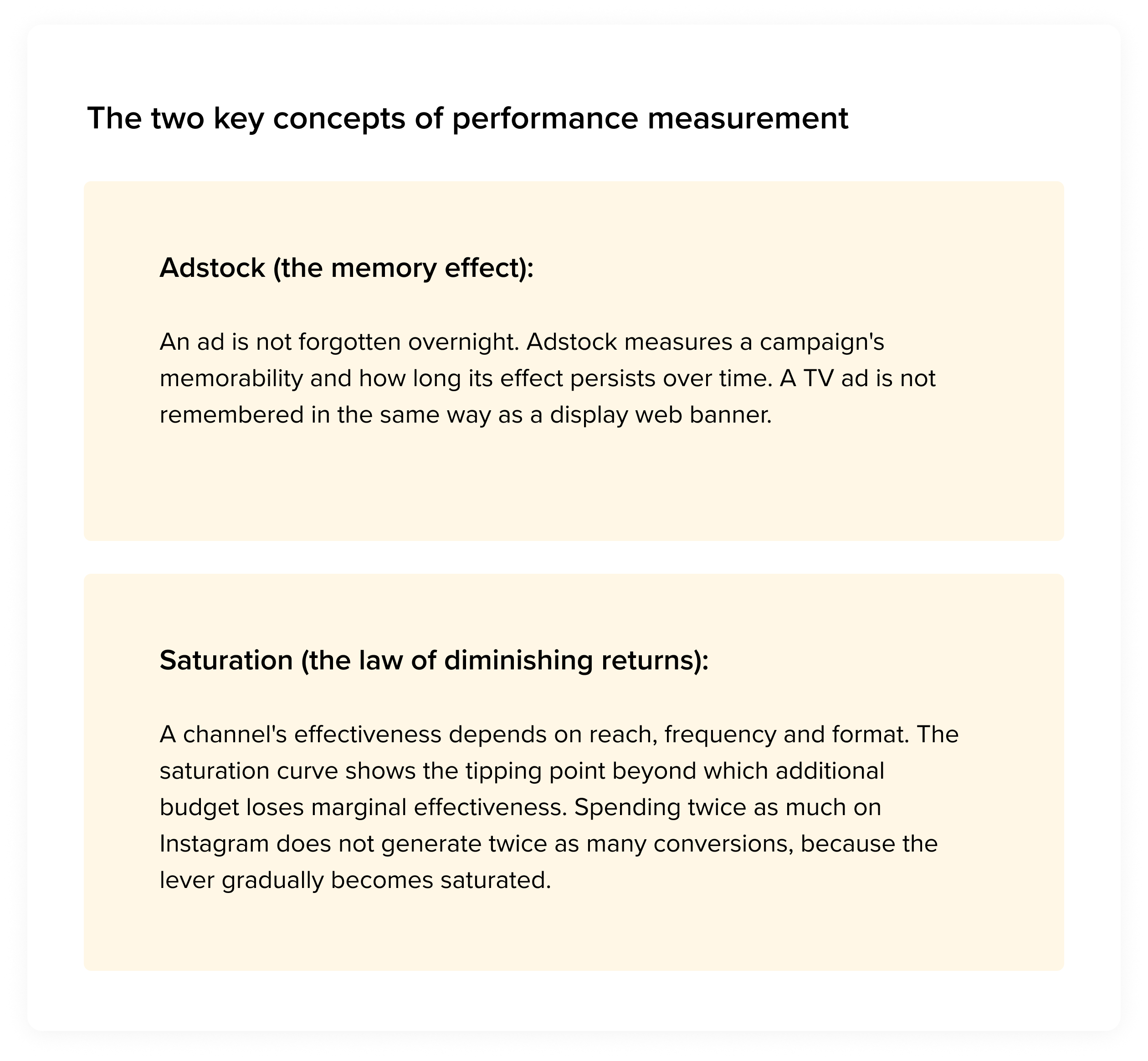
Led by the open-source momentum of major tech players and specialized labs, Bayesian modeling3 makes it possible to combine historical analysis with business knowledge known as priors. This statistical rigor is built around two fundamental mechanisms for interpreting marketing performance: Adstock, which reflects how long advertising stays in memory over time, and Saturation, which defines the point of diminishing returns beyond which additional investment loses effectiveness.
To meet the full range of performance needs without imposing a one-size-fits-all model, fifty-five offers a modular approach made up of three complementary solutions of increasing complexity.
A. The High-Performance Open-Source Standard
Built on the open-source Bayesian algorithmic frameworks developed by Google and PyMC Labs, Meridian and PyMC Marketing are the modern, transparent standards for marketing performance measurement. They analyze aggregated media and sales data, incorporating detailed geographic (national, regional…) and time dimensions.
Their value lies in expert implementation by our teams. We have built extensive experience through numerous deployments of these two models for different advertisers, across different brands and markets. Their use is packaged, and our MMM expertise allows us to configure the Bayesian framework with your business data (priors) and leverage your past incrementality tests (Lift Tests) to calibrate the model and move from simple correlation to true causation.
This offering takes the robust structure of Meridian or PyMC and augments it with an architecture of Artificial Intelligence Agents at every step of the process.
The 3 types of AI agents deployed:
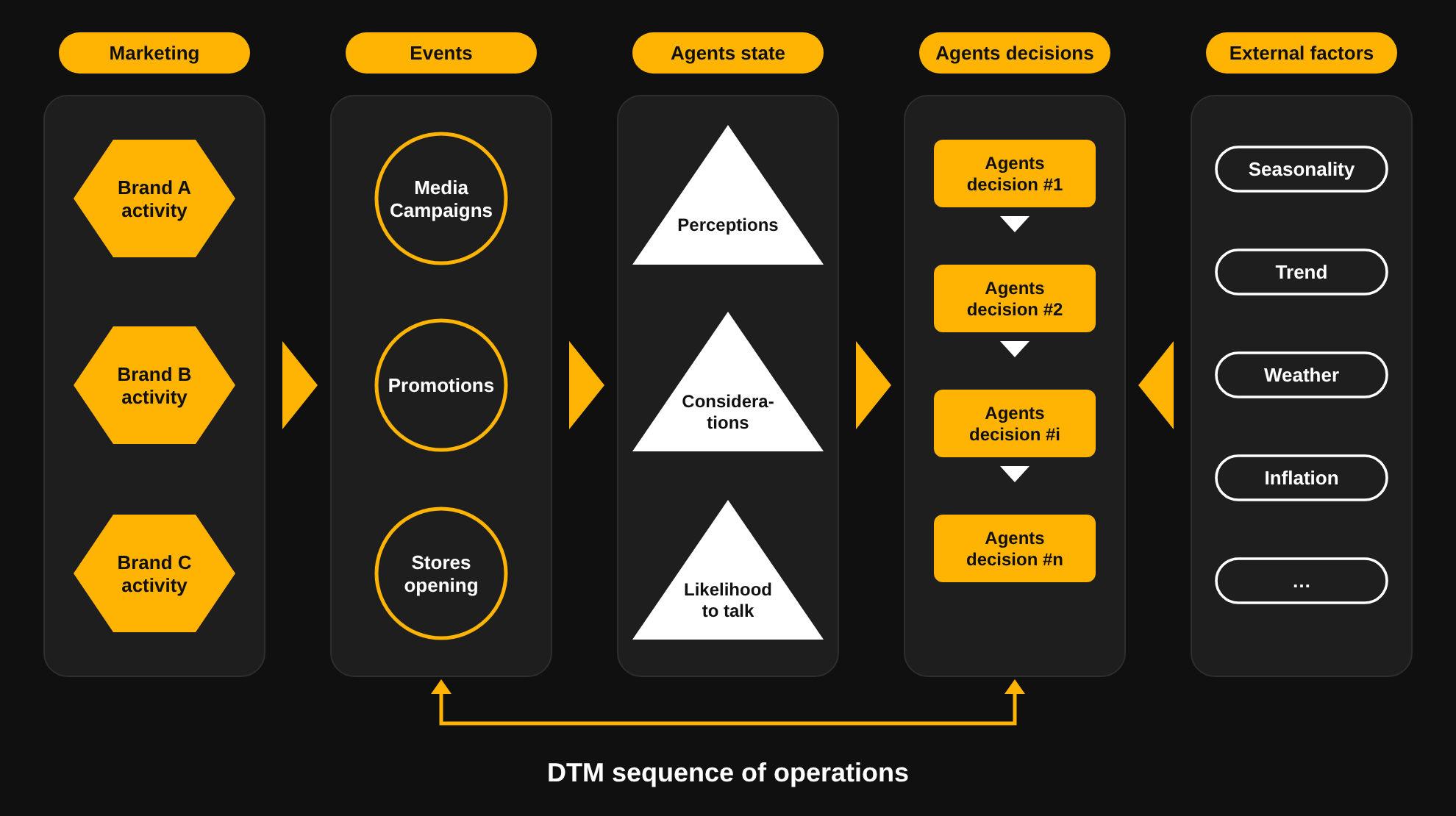
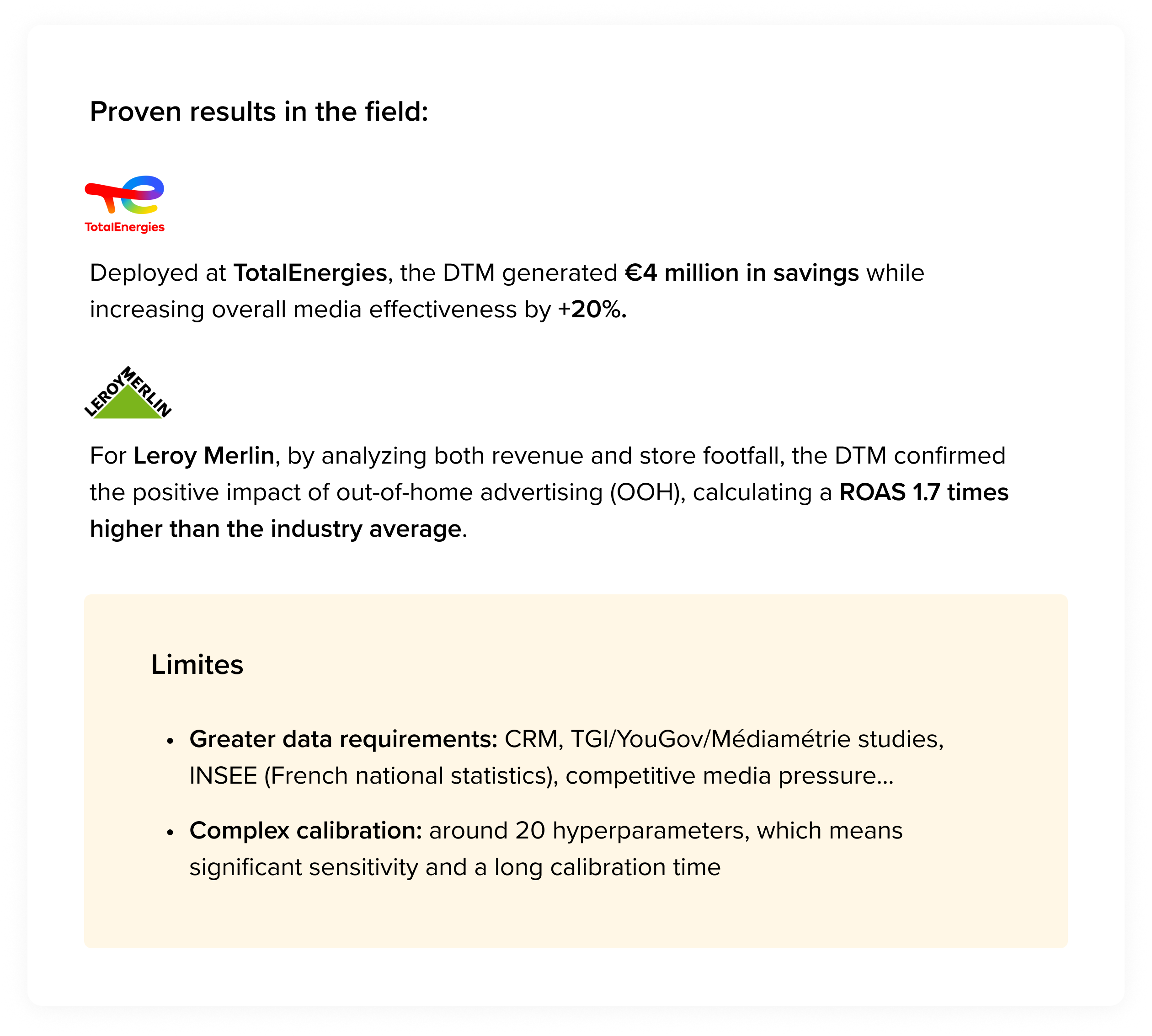
The Digital Twin Model (DTM) is the major technological breakthrough developed by fifty-five. Rather than calculating statistical averages on aggregates (a Top-Down approach), the DTM takes a Bottom-Up approach based on Agent-Based Modeling (ABM). It recreates a synthetic population4 of between several thousand and one million Digital Twins (virtual consumers) representative of your market (age, gender, location, media habits, brand perception).

A Digital Twin's decision journey:
fifty-five's approach does not pit Bayesian models against digital-twin simulation; instead, it combines them within a continuous steering loop. The Digital Twin Model acts as a medium- to long-term strategic compass: it makes behavioral mechanisms explicit, assesses brand value and provides Meridian or PyMC with a causal structure and well-founded priors. Conversely, Meridian or PyMC is used to measure variations observed on direct levers more frequently, serving as a fast statistical validation layer and an early-warning indicator for fine-tuning the DTM's calibration on an ongoing basis.
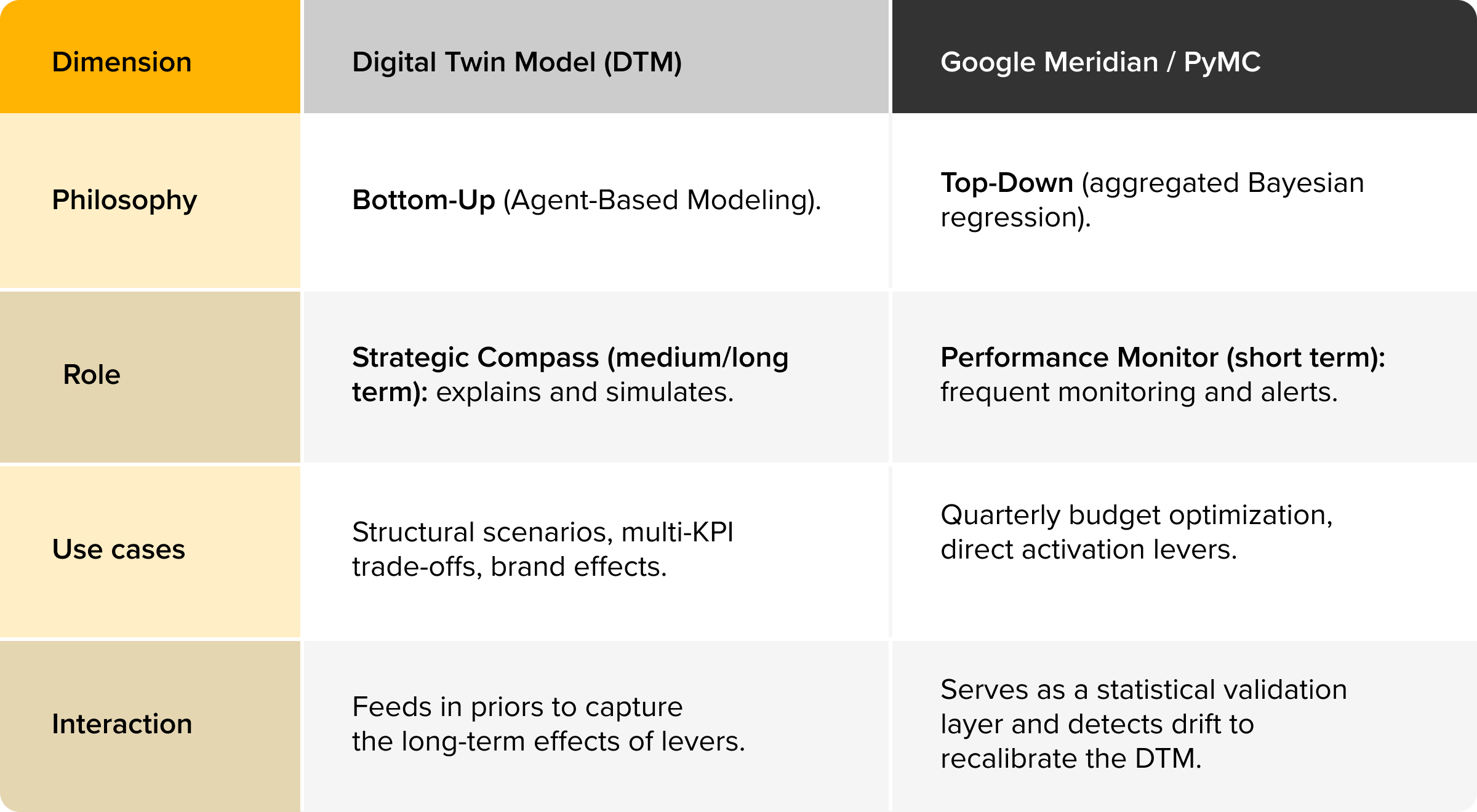
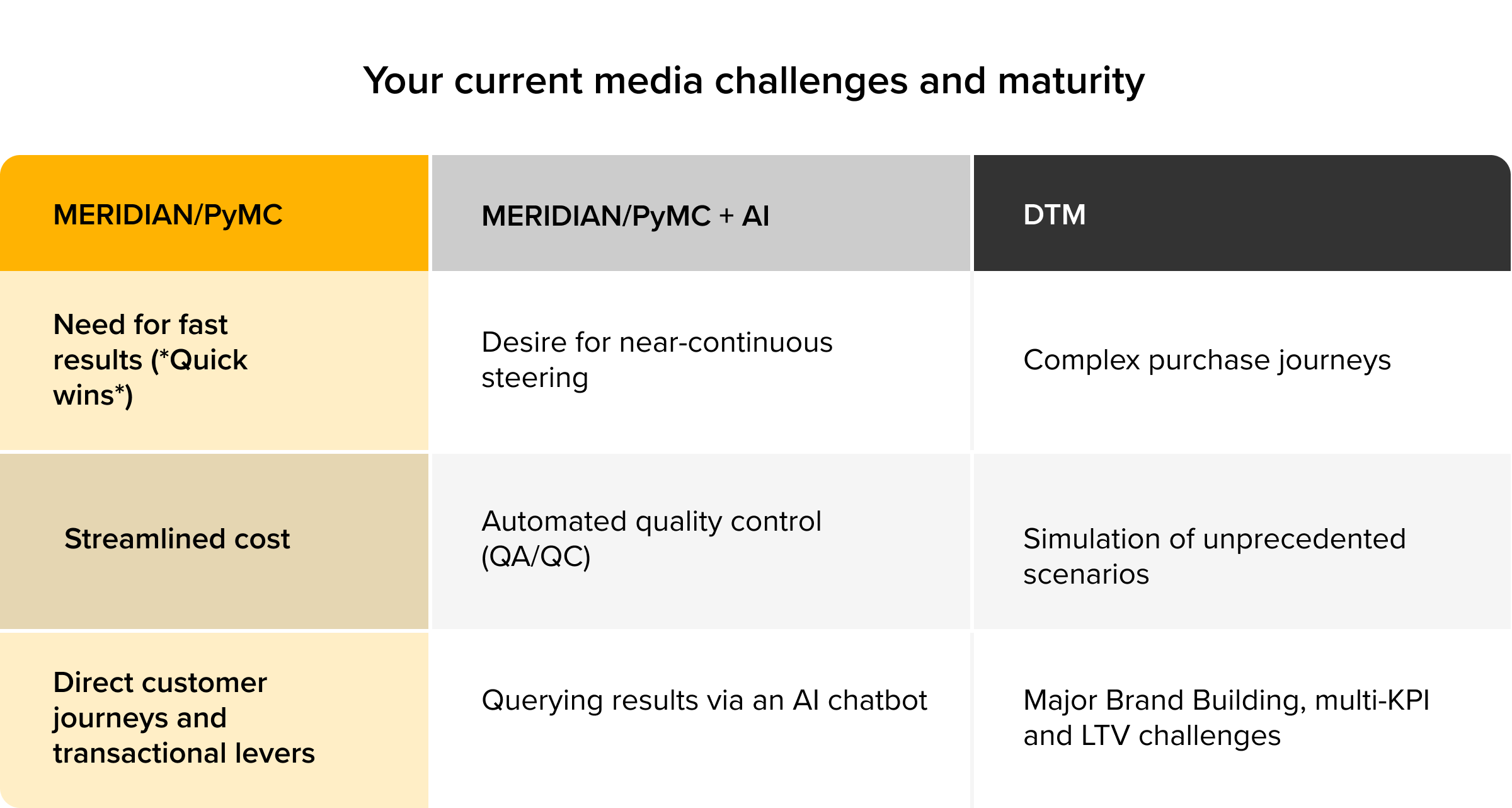
The right path depends directly on objectives, scope (geographies, brands) and maturity in marketing measurement and data. Implementing Meridian or PyMC is recommended for companies seeking agile budget validation on direct customer journeys and short-term activation channels. The AI-augmented option is particularly well suited to organizations looking to automate their data flows and establish continuous steering. Finally, the Digital Twin Model is the natural choice for players facing complex purchase journeys and multi-KPI trade-offs between brand image and conversion, or wishing to simulate structural budget decisions. Within an international organization, depending on the markets or brands to be modeled, several models can coexist while sharing a common technological and organizational foundation to run the MMM program. By building an internal, long-lasting decision-making asset in this way, brands secure controlled, predictive management of their future growth.
Combining the rigor of open-source Bayesian algorithms with the innovation of Agent-Based Modeling, fifty-five has established itself as a pioneer in next-generation marketing measurement. Its R&D work has been published in renowned international scientific venues (notably at the IFAAMAS academic AI conference).
Adopting a Next-Gen MMM is not about buying yet another piece of software, but about building an internal, long-lasting and scalable decision-making asset. Whether you want to start with an agile first step using Meridian to prove the value of MMM, or deploy the predictive power of the Digital Twin Model from the outset, fifty-five supports you from data structuring all the way to adoption by your operational teams. Contact our teams for a flash audit of your current models or to schedule a tailored demo of the Digital Twin Model.
References and glossary
1Study by Google & BCG
2Frequentist approaches: These estimate the effect of each marketing lever solely from historical data, usually through mathematical regression. The result is a single value per parameter, together with a confidence interval. They are quick and simple to implement, but become unstable when data is limited or channels are highly correlated.
3Bayesian approaches: These combine historical data with prior knowledge ("priors"), such as benchmarks, incrementality test results or business expertise. Instead of a single value, they give a distribution of probable values for each parameter, which makes uncertainty explicit. They are more robust when data is scarce, but require more computation and well-justified choices of priors. This is the approach taken by recent open-source frameworks such as Meridian (Google) and PyMC-Marketing.
4Synthetic population: A set of fictional individuals created to reproduce the statistical characteristics of a real population: socio-demographic distribution, purchasing behavior, media exposure… Each individual is invented, but the whole is representative. It is built from aggregated sources such as census data, panels or first-party data. It is used to simulate behaviors or test scenarios without using any personal data.

Discover all the latest news, articles, webinar replays and fifty-five events in our monthly newsletter, Tea O'Clock.